Learning To Fly
Seven Days To A Multi-Engine Rating: Monday To Checkride
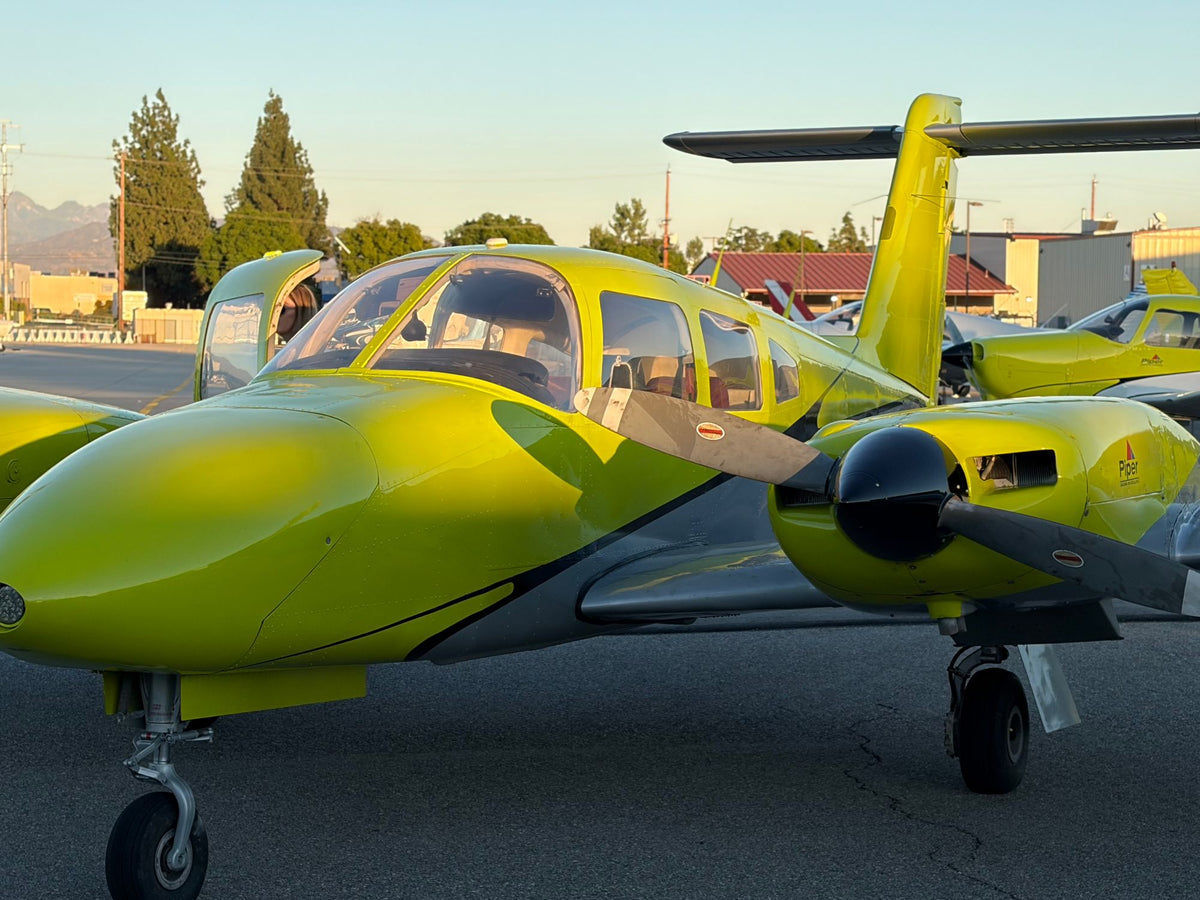
Most ratings take months. The multi-engine rating is the exception, and our accelerated course runs it in seven days: classes start on a Monday, you fly the Piper Seminole twice a day through the week, and the checkride is scheduled for the same weekend. This post explains why the FAA's rules make a one-week rating possible, what the week looks like, what the $5,100 covers, and how to arrive on Monday ready to use every hour of it.
Quick answer: Our multi-engine course runs seven days in the Piper Seminole: start on a Monday, fly twice a day, take the checkride that weekend, with Sunday kept as a buffer. It costs $5,100 for 8 hours in the Seminole, 2 hours in the full-motion simulator, 10 hours of instruction and 2 hours of ground, with the examiner paid separately. You need a private or commercial certificate and a current medical, and should reserve at least a month ahead.
Book A Free Consultation Call Or Text (818) 330-1318
Why The FAA Rules Allow A One-Week Rating
Adding a multiengine class rating to a certificate you already hold is governed by 14 CFR 61.63(c). It asks for two things: a logbook or training record endorsement from an authorized instructor saying you were found competent in the knowledge areas and proficient in the areas of operation, and a passed practical test. The same paragraph says you need not meet the training-time requirements that apply to the certificate, and need not take an additional knowledge test if you already hold an airplane rating at that certificate level.
So there is no FAA hour minimum and no written exam. What there is, is a standard. The practical test follows the Airman Certification Standards for your certificate level, the private pilot ACS (FAA-S-ACS-6C) or the commercial pilot ACS (FAA-S-ACS-7B), both effective May 31, 2024. Their Multiengine Operations area includes maneuvering with one engine inoperative and the VMC demonstration, and the emergency operations area adds engine failure during takeoff before VMC, engine failure after liftoff, and an approach and landing with an inoperative engine. Our multi-engine rating requirements page walks through them.
The Week At A Glance
| Day | Main Work |
|---|---|
| Monday | Seminole systems on the ground, a first simulator session, a familiarization flight |
| Tuesday | Two flights: engine failure in cruise, identify, verify, feather, and single-engine handling |
| Wednesday | Simulator on takeoff emergencies, then the VMC demonstration and engine failures after liftoff |
| Thursday | Single-engine approaches to a full stop and oral preparation |
| Friday | Mock oral with a second instructor and a polish flight |
| Saturday | The practical test with a designated pilot examiner |
| Sunday | Buffer for weather or scheduling |
Weather, examiner availability and your own progress move things around, and your instructor will tell you midweek whether the weekend ride is realistic. The full day-by-day plan is on our accelerated multi-engine rating page.
Why A Week Works Better Than Weekends
Nothing in the multi-engine rating is conceptually hard. There is no new navigation or airspace. What is new is a short list of actions that have to become reflexes: identify the failed engine, verify it, feather it, and do it with the right hand on the right lever while the airplane is trying to roll. Reflexes come from repetition with short gaps. Fly engine-out drills on Tuesday and again on Wednesday and you keep them. Fly them once a month and you rebuild them every time, which costs hours.
Book A Free Consultation Call Or Text (818) 330-1318
What The $5,100 Covers
The course is one fixed price: 8 hours in Seminole N311EF, 2 hours in the Redbird MCX full-motion simulator, 10 hours of flight instruction across the airplane and simulator, and 2 hours of ground and briefings. The examiner's fee is paid to the examiner, and our page on checkride fees in Southern California explains how that works. The course can be paid as $2,500 down and two payments of $1,300. The multi-engine rating cost page breaks the figure down line by line.
Are You Ready For Monday?
Tick what is already true. The more of this you finish before you arrive, the more of the week goes into flying.
- I hold a private or commercial pilot certificate
- My medical certificate is current
- I have reserved my week at least a month ahead
- I have read the Seminole's fuel, electrical and propeller systems
- I know VMC, VYSE, VSSE and VXSE without looking them up
- I can explain the factors that affect VMC
- I have read the engine failure procedures in the flight manual
- I have budgeted for the examiner's fee
- I have arranged somewhere to sleep properly all week
Two things decide how the week goes. The first is sleep: two flights a day is tiring, and pilots who fly in from out of town and run on four hours a night struggle by Thursday. Our guide to housing for out-of-town students helps with the practical side. The second is reading before Monday. The multi-engine oral exam guide covers the questions in the form an examiner asks them, and our Piper Seminole PA-44-180 page has the specifications.
Frequently Asked Questions
How Long Does A Multi-Engine Rating Take?
Our course runs seven days: start on a Monday, fly twice a day, and take the checkride that weekend, with Sunday kept as a weather and scheduling buffer.
Is There A Minimum Number Of Hours For A Multi-Engine Rating?
No. Under 14 CFR 61.63(c)(3), an applicant for an additional class rating need not meet the training-time requirements for the certificate. Our course includes 8 hours in the Seminole because that is what reaching the standard usually takes.
Is There A Written Test For The Multi-Engine Rating?
No additional knowledge test is needed if you already hold an airplane rating at that certificate level, under 14 CFR 61.63(c)(4). There is an oral exam as part of the practical test.
How Much Does The Seven-Day Course Cost?
$5,100 for the course, which can be paid as $2,500 down and two payments of $1,300. The examiner's fee is paid separately.
What Do I Need Before I Start?
A private or commercial pilot certificate, a current medical certificate, and a reservation at least a month ahead so the examiner can be booked for the weekend.
Book A Free Consultation Call Or Text (818) 330-1318
For the local course page, see multi-engine rating in Los Angeles.
Sources: 14 CFR 61.63(c), Additional aircraft class rating; FAA-S-ACS-6C, Private Pilot for Airplane Category ACS; FAA-S-ACS-7B, Commercial Pilot for Airplane Category ACS.
Fly It Yourself
Lesson One Is A Discovery Flight
Sixty minutes from the left seat over Los Angeles with an FAA-certificated instructor beside you, logged as dual instruction toward a license. The quickest way to see what any of this means is to fly an hour of it.
Talk to an instructor or the owner — 9 AM–9 PM, 7 days


